

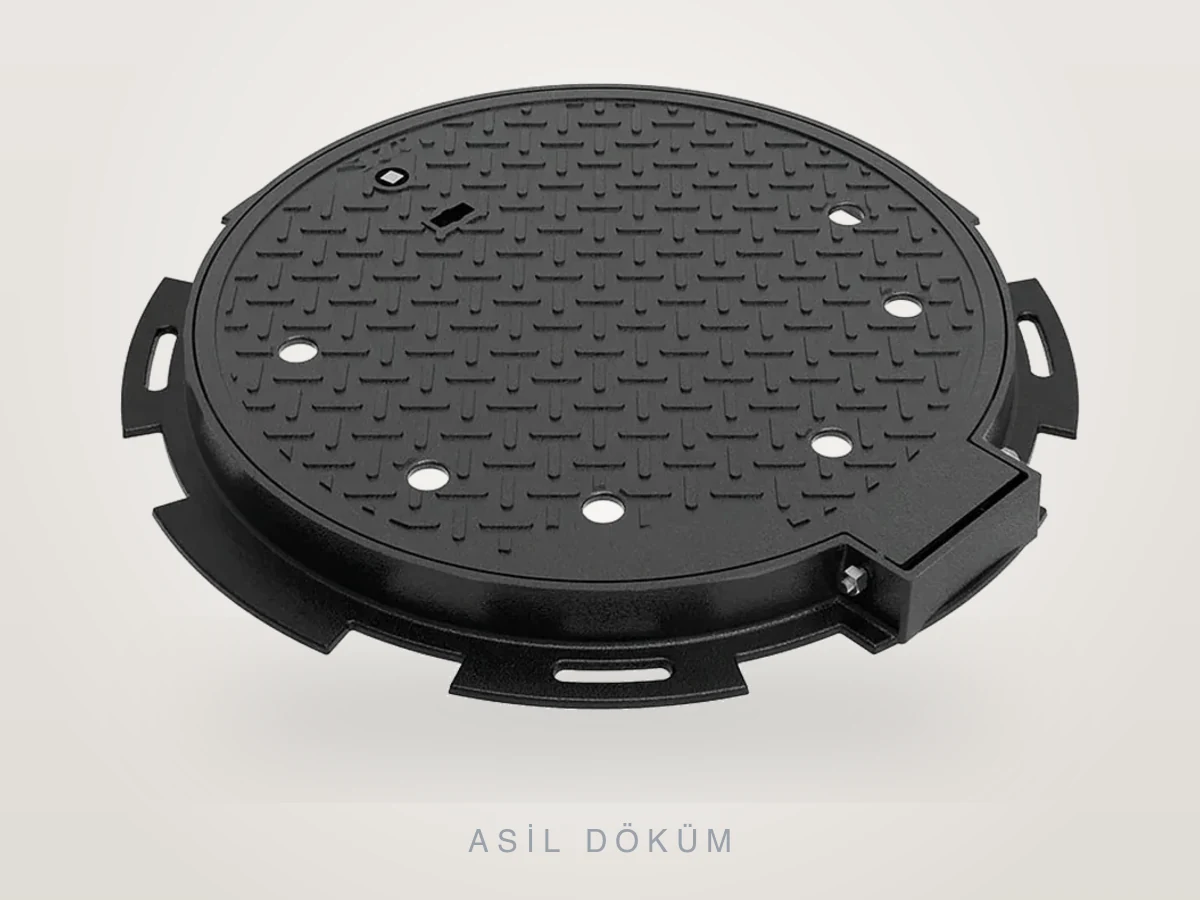
Short answer: Manhole covers are classified along four axes: size (the round Ø600 standard, square and rectangular formats), material (ductile iron, composite, plastic), fittings (sealed, hinged, screw-locked, ventilated) and EN 124 load class (B125, C250, D400). The right type sits at the intersection of these four axes, driven by the traffic load at the installation point, the chamber opening and operational needs.
Manhole Covers by Size and Geometry
Round Manhole Covers (the Ø600 Standard)
The round cover is the most common type in urban infrastructure. For inspection chambers that require human entry, a clear opening of Ø600 mm is the de facto standard. Round geometry offers two practical advantages: the diameter is identical in every orientation, so the cover cannot fall into the chamber, and it seats on the frame without corner alignment. In sewer, stormwater and telecom networks the first choice is usually a round manhole cover.
Square and Rectangular Manhole Covers
Square and rectangular formats serve valve chambers, meter boxes, cable galleries and wide manhole openings. Rectangular covers can be produced in multiple sections to close openings a single round cover could never span. Their drawback is that the diagonal is longer than the side, so a cover held diagonally can drop into the chamber; hinges or safety chains manage this risk. See the square and rectangular manhole covers page for sizes.
Manhole Covers by Material
Ductile Iron (GGG50)
Ductile iron, also called spheroidal graphite cast iron (GGG50), is the reference material for covers under heavy traffic. Its spheroidal graphite structure gives higher tensile strength and ductility than grey cast iron, so a cover deforms under sudden load instead of fracturing. It is the de facto standard for class D400 and above. Its drawbacks are weight and theft risk driven by its scrap value. Browse the range on the cast iron manhole covers category page.
Composite Manhole Covers
Glass fibre reinforced composite covers have spread for two main reasons: they have no scrap value, so they are not stolen, and they are markedly lighter than cast iron; they also resist corrosion and do not conduct electricity. Composite round and composite square/rectangular types mirror most of the cast iron range; all options are listed under composite infrastructure products. For a detailed comparison, read cast iron vs composite manhole covers.
Plastic (Polymer) Covers
Plastic covers are the economical option for light-duty scenarios such as gardens, landscaping and pedestrian areas; they have structural limits in higher load classes and should never be used where vehicles pass.
Types by Fittings
Sealed (Gasketed) Covers
An elastomer gasket between cover and frame provides odor, gas and noise tightness. Sealed covers are preferred indoors, in car parks and around residential chambers; the gasket also stops rattling under traffic.
Hinged Covers
A hinge lets a single worker open the cover and prevents it from being separated from the frame and lost; on frequently serviced lines it speeds up intervention and improves work safety.
Screw-Locked Covers
Covers locked with bolts or a dedicated key block unauthorized access and vandalism; they are common on critical telecom, power and water utility chambers. The lock also prevents the cover from being lifted by internal pressure on high-flow lines. On the grating side, the same need is met by locking channel gratings.
Ventilated Covers
A perforated body prevents gas accumulation inside the chamber and balances pressure; the trade-off is that it lets odors out and some surface water in. If collecting surface water is the actual goal, the right product is a rainwater grating, not a cover.
By Load Class: B125, C250, D400
EN 124 classifies covers by test load: B125 (125 kN) for pedestrian areas and car parks, C250 (250 kN) for kerbside zones and road edges, and D400 (400 kN) for every road open to traffic. A15 (15 kN) is limited to pedestrian and green areas, while E600 (600 kN) and F900 (900 kN) serve ports and industrial sites. See the EN 124 load classes guide for details.
Summary Table
| Type | Typical location | Key feature |
|---|---|---|
| Round ductile iron (Ø600) | Roads open to traffic, sewer manholes | Cannot fall into the chamber; suits D400 |
| Square/rectangular cast iron | Valve chambers, cable galleries | Multi-part designs for large openings |
| Composite cover | Parks, theft-prone areas | No scrap value; lightweight |
| Sealed (gasketed) cover | Indoor areas, car parks | Odor and gas tightness |
| Hinged cover | Frequently serviced lines | Opened by one worker |
| Screw-locked cover | Telecom, power and water chambers | Blocks unauthorized access |
How Do You Choose the Right Type?
In practice the order is: first the load class based on the installation point, then size based on the chamber opening, then material based on environment and theft risk, and finally the fittings based on operational needs. For a step-by-step method, use the how to choose a manhole cover guide. Asil Dokum, as a manufacturer producing both ductile iron and composite in-house, offers the same sizes and classes in both materials; since prices vary with size, class and quantity, request a quote for your project.
Frequently Asked Questions
Why are manhole covers usually round?
A round cover has the same diameter in every direction, so it cannot fall into the chamber; it also seats on the frame without corner alignment.
What is the standard manhole cover size?
For chambers that require human entry, a clear opening of Ø600 mm is the common standard. Square and rectangular sizes are specified per project.
Should I choose ductile iron or composite?
GGG50 ductile iron is the reference for heavy vehicle traffic. Composite covers have no scrap value, so they are preferred where theft is a risk and in corrosive environments.
Which load class do I need?
Use B125 for pedestrian areas and car parks, C250 for kerbside zones and road edges, and D400 for every road open to traffic. When in doubt, one class higher is the safe option.
How much does a manhole cover cost?
Prices depend on material, size, load class and quantity; request a quote with your product and quantity details for exact figures.
[{"q": "Why are manhole covers usually round?", "a": "A round cover has the same diameter in every direction, so it cannot fall into the chamber; it also seats on the frame without corner alignment."}, {"q": "What is the standard manhole cover size?", "a": "For chambers that require human entry, a clear opening of Ø600 mm is the common standard. Square and rectangular sizes are specified per project."}, {"q": "Should I choose ductile iron or composite?", "a": "GGG50 ductile iron is the reference for heavy vehicle traffic. Composite covers have no scrap value, so they are preferred where theft is a risk and in corrosive environments."}, {"q": "Which load class do I need?", "a": "Use B125 for pedestrian areas and car parks, C250 for kerbside zones and road edges, and D400 for every road open to traffic. When in doubt, one class higher is the safe option."}, {"q": "How much does a manhole cover cost?", "a": "Prices depend on material, size, load class and quantity; request a quote with your product and quantity details for exact figures."}]