

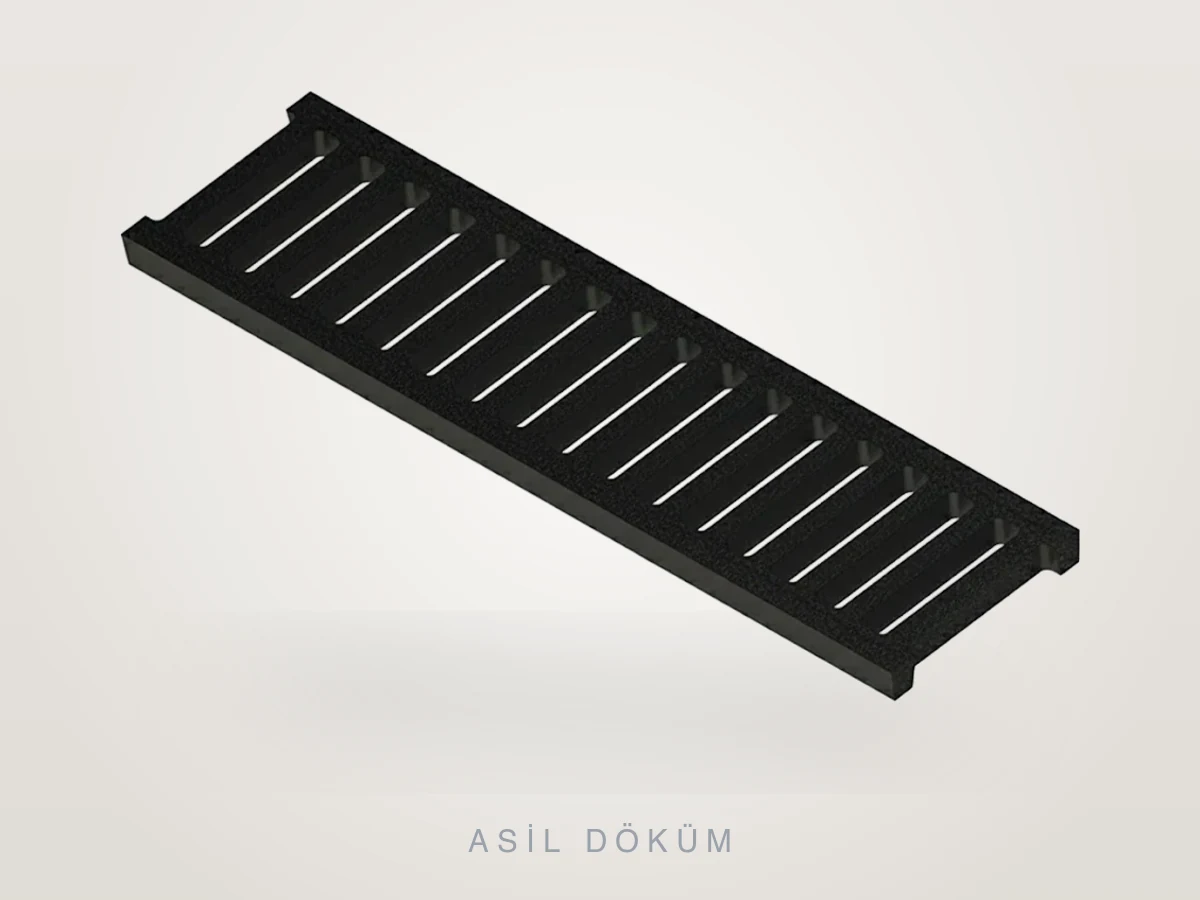
Short answer: C250 and D400 are two separate load classes in the EN 124 standard. C250 products are verified under a 250 kN test load (roughly 25 tonnes) and D400 products under 400 kN (roughly 40 tonnes). C250 is intended only for the kerbside and narrow strips at the road edge; every point where a vehicle wheel can bear fully on the cover requires D400.
Both Classes Come from the Same Standard: EN 124
The loads that manhole covers, channel gratings and gully tops must carry are divided into six classes in EN 124: A15 (15 kN), B125 (125 kN), C250 (250 kN), D400 (400 kN), E600 (600 kN) and F900 (900 kN). Because both relate to the road, C250 and D400 are the most frequently confused pair; yet their scopes are completely different. For the full class system, see the EN 124 load classes guide.
Test Loads: What Do 250 kN and 400 kN Actually Mean?
The load class refers to the control load applied to the product through a press during type testing: C250 products are tested under 250 kN (roughly 25 tonnes) and D400 products under 400 kN (roughly 40 tonnes). These figures are not vehicle weights; the static load transferred by a single wheel of a 40 tonne truck is far below them. However, braking, impact and repeated passes multiply the static load through dynamic effects; the test loads cover these stresses together with a safety margin. The fact that a D400 product carries 60 percent more test load means its body section, ribbing and seating surface are designed accordingly.
Which Class Goes Where?
C250: Kerbside and Road Edge Strips
C250 corresponds to Group 3 of the standard: the gully zone along the kerb and the narrow strips of the carriageway and footway adjacent to it. In practice this is a strip extending at most 0.5 m into the carriageway and at most 0.2 m into the footway, measured from the kerb. Rainwater gratings and gully tops along the road edge are typical examples; in this zone a wheel bears on the product partially and occasionally.
D400: Every Road Open to Traffic
D400 corresponds to Group 4: carriageways of roads used by all types of road vehicles, hard shoulders and parking areas. Urban streets, main arteries, internal roads of industrial plants and car parks all fall within this scope. Cast iron manhole covers and channel gratings installed in trafficked roads are typically produced in class D400.
The Practical Decision Rule: Does the Wheel Bear Fully?
One question is enough: can a vehicle wheel bear fully on the cover or grating? If the wheel can pass over the product with its full width, the point is open to traffic and D400 is required. If the wheel touches only the edge, partially and occasionally, C250 may be sufficient. The fact that vehicles do not normally enter the area is no guarantee; bad parking, mounting the kerb and service vehicles produce this scenario regularly.
C250 vs D400, Criterion by Criterion
| Criterion | C250 | D400 |
|---|---|---|
| Test load | 250 kN (roughly 25 tonnes) | 400 kN (roughly 40 tonnes) |
| Application zone | Kerbside gullies; a strip extending at most 0.5 m into the road and 0.2 m into the footway | Carriageways, hard shoulders, car parks; every point open to traffic |
| Wheel contact | Partial and occasional | Full and continuous |
| Risk if misused | Fatigue failure if used within the carriageway | No technical drawback at the kerbside, minor extra cost |
The Consequence of the Wrong Choice: Fatigue Failure
A C250 product installed at a point open to traffic usually does not break on the first day, which is exactly why the problem is noticed late. Repeated wheel passes create stresses that stay below the ultimate strength of the material yet leave cumulative damage with every cycle. The result is fatigue failure: first rocking and noise in the frame, then corner cracks, finally sudden breakage of the body. A cover that breaks in the road can cause vehicle damage and injuries, and the liability stays with the operator. For the selection steps, see our guide on how to choose a manhole cover.
The Price and Weight Difference Is Small in Practice
Because of its thicker sections, a D400 product is somewhat heavier than a C250 product of the same size, and its price is correspondingly higher. Yet this difference remains small next to the total installation cost, which includes excavation, concrete, labour and traffic management. Replacing a broken cover, however, costs far more than the gap between the two classes. For a current, project specific figure, simply request a quote.
When in Doubt, Go One Class Up: Specifications Agree
The established rule is simple: if there is any doubt about the required class, choose the higher one. Municipalities and water utilities likewise require D400 at every point open to traffic and restrict C250 to the kerb line. On the material side, D400 covers are traditionally produced from GGG50 ductile iron; composite infrastructure products, which eliminate theft risk because they have no scrap value, are becoming widespread in both classes as well. As a manufacturer producing both cast iron and composite, Asil Döküm verifies both materials with the same load class tests; for the material decision, see the cast iron vs composite comparison.
Frequently Asked Questions
Can a C250 cover be installed in a road open to traffic?
No. Every point where a vehicle wheel can bear fully on the cover requires D400. C250 is intended only for the kerbside gully zone and narrow road edge strips; using it within the carriageway leads to fatigue failure over time.
How many tonnes do 250 kN and 400 kN correspond to?
250 kN corresponds to a test load of roughly 25 tonnes and 400 kN to roughly 40 tonnes. These values are not vehicle weights but control loads applied by a press during type testing.
Is C250 sufficient for a car park?
No. In EN 124, parking areas fall under D400, because the wheel bears fully on the cover and manoeuvring creates additional loads. D400 should be used in car parks.
How big is the price difference between C250 and D400?
The difference depends on size and material, but it represents a small share of the total installation cost. The soundest approach is to request a quote from the manufacturer for a current, project specific figure.
Which class do municipal specifications require?
Municipalities and water utilities require D400 at every point open to traffic; C250 is accepted only in limited applications such as rainwater gratings along the kerb line. For tendered works, check the current specification of the relevant authority.
[{"q":"Can a C250 cover be installed in a road open to traffic?","a":"No. Every point where a vehicle wheel can bear fully on the cover requires D400. C250 is intended only for the kerbside gully zone and narrow road edge strips; using it within the carriageway leads to fatigue failure over time."},{"q":"How many tonnes do 250 kN and 400 kN correspond to?","a":"250 kN corresponds to a test load of roughly 25 tonnes and 400 kN to roughly 40 tonnes. These values are not vehicle weights but control loads applied by a press during type testing."},{"q":"Is C250 sufficient for a car park?","a":"No. In EN 124, parking areas fall under D400, because the wheel bears fully on the cover and manoeuvring creates additional loads. D400 should be used in car parks."},{"q":"How big is the price difference between C250 and D400?","a":"The difference depends on size and material, but it represents a small share of the total installation cost. The soundest approach is to request a quote from the manufacturer for a current, project specific figure."},{"q":"Which class do municipal specifications require?","a":"Municipalities and water utilities require D400 at every point open to traffic; C250 is accepted only in limited applications such as rainwater gratings along the kerb line. For tendered works, check the current specification of the relevant authority."}]